
Evanston Epoxy Flooring has prepared and coated concrete for 20+ years, and we install ESD flooring in Evanston, IL, serving surrounding cities including Lincolnwood, Winnetka, Norridge, Schiller Park and River Grove. An ESD floor is a resin system built to carry static charge safely to ground, protecting sensitive electronics and, in some rooms, reducing the risk of a spark near flammable vapors.
Unlike a decorative coating, an ESD floor is judged by a number. Each system is built to an electrical resistance range set by the owner, the equipment maker or the facility’s ESD control program, and we test the finished floor against that range and hand over the readings.
Types of ESD Flooring
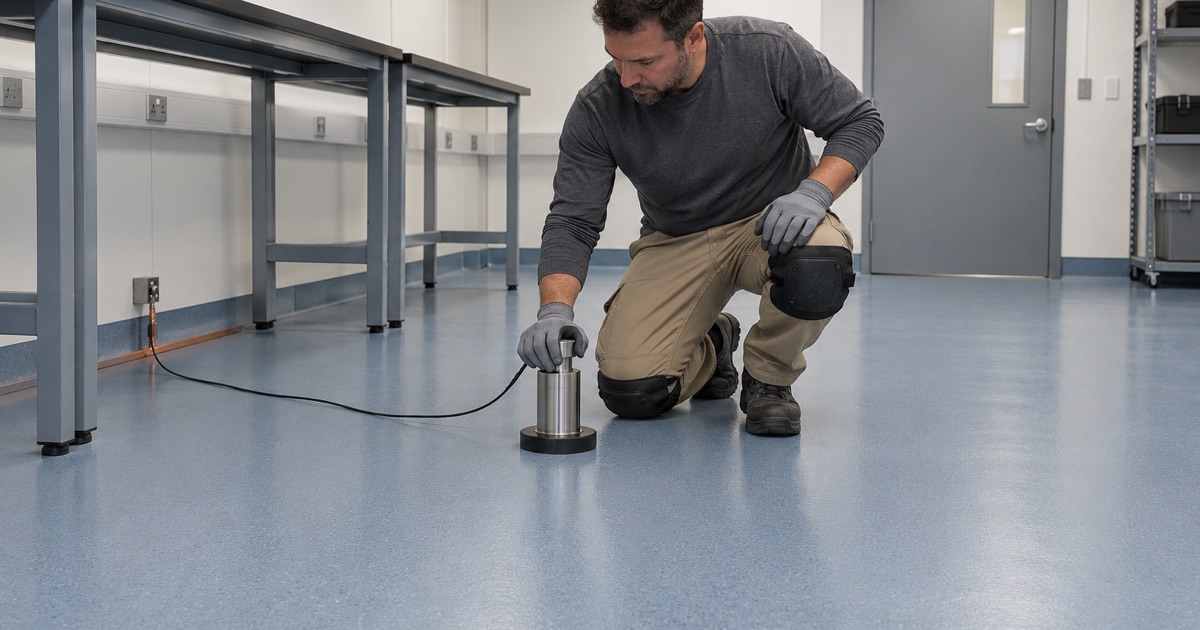
Static-Dissipative Epoxy Floors
A static-dissipative floor carries charge to ground in a controlled way, slowly enough to avoid a sudden discharge but quickly enough to keep charge from building on people and carts. It is the most common choice for electronics assembly, testing and repair areas.
The floor is a multi-layer system: a primer, a conductive layer with copper grounding strips tied into the building ground, and a static-dissipative topcoat. The order and the materials are written into the proposal.
Conductive Floors
A conductive floor has lower resistance than a static-dissipative one and drains charge faster. It is specified where the standard calls for it, such as some areas handling sensitive components or where flammable materials are present. Because the right choice depends on what is being protected, we take the required range from your ESD program or equipment specifications rather than picking one ourselves.
Where ESD Floors Are Used
Electronics manufacturing and repair, server and data rooms, laboratories with sensitive instruments, clean rooms and some healthcare and research spaces all use ESD flooring. Each has its own traffic, cleaning and chemical demands, and the topcoat is chosen with those in mind as well as its electrical properties.
A data room with raised access flooring is a different case from a slab floor, and an ESD coating applies to the slab rather than to raised panels. We look at how the room is built before recommending anything, and tell you plainly when a coating is not the right tool.
Building an ESD Floor That Tests in Range
Surface Preparation and Moisture
An ESD floor starts like every floor we install: the slab is diamond ground or shot blasted to an ICRI profile, cracks are repaired, and old coatings and adhesives come off. We do not acid etch.
Slabs on grade are tested for moisture before coating. Moisture problems that blister an ordinary coating also break the conductive layer of an ESD floor, so a moisture-mitigation primer goes down where the readings call for it.
Grounding Points and Conductive Layers
The floor has to be connected to the building’s ground. Copper strips are laid under the conductive layer and run to grounding points, which an electrician confirms are tied into a proper ground. The number and placement of grounding points depend on the size and layout of the room.
Skipping or misplacing a ground connection is one of the most common reasons an ESD floor fails its test, so we lay them out on a drawing before the work starts.
Film Thickness and Even Application
The electrical performance of the topcoat depends on applying it at the thickness the maker specifies, evenly across the room. Too thick or too thin and the resistance drifts out of range in those spots. We write the system build and the finished thickness into the proposal, and measure wet film thickness as the coating goes down rather than relying on coverage alone.
Testing and Handover
Resistance Testing on the Finished Floor
After cure, we measure resistance point to point across the floor and from the surface to the ground connection, using a calibrated meter. Readings are taken across the room, not in one convenient corner. The results are recorded on a floor plan and handed over with the floor, so your quality team has a baseline to compare future checks against.
Footwear, Furniture and the Rest of the System
An ESD floor only protects work when people and equipment are connected to it. Conductive footwear or heel straps, grounded workbenches and conductive casters on carts are part of the same system. We coordinate with whoever runs your ESD program so the floor fits into it.
Chairs and stools matter too. Standard plastic glides insulate a seated worker from the floor, so ESD chairs with conductive casters or drag chains are part of the plan. We list the items that need to change in the proposal, even when someone else supplies them.
Cleaning and Maintenance
Ordinary waxes, floor finishes and some cleaners leave an insulating film that pushes resistance out of range. We provide written cleaning instructions and recommend periodic resistance checks, especially after any change in cleaning products or contractors.
Heavy traffic, rolling carts and dragged equipment wear the topcoat over time, and a worn area can test differently from the rest of the floor. A worn topcoat can be sanded and recoated with the same ESD product, then retested, without replacing the whole system.
Commercial Scheduling and Compliance
Installing Around Operations
Electronics and lab spaces often cannot shut down for long. We phase work room by room, keep grinding dust contained away from sensitive equipment, and schedule the loud work inside the town’s construction hours. The written schedule shows when each room is closed, when it can take foot traffic, and when equipment can be moved back in.
VOC Limits and Product Choice
Every ESD coating we install is chosen within the Illinois VOC limits under 35 Ill. Adm. Code Part 223, which bind the installer as well as the manufacturer. We supply product data sheets and the resistance specifications with the proposal, so facilities and safety staff can review them before the job is booked.
- 20+ Years in Business
- Moisture Testing in Every Quote
- Written Proposals