
Evanston Epoxy Flooring has 20+ years behind every basement floor epoxy job we take on in Evanston, IL, serving surrounding cities including Lincolnwood, Winnetka, Norridge, Schiller Park and River Grove. A basement floor is a coating job with groundwater on the other side of it, so the first thing we put in any basement proposal is a moisture test, not a color.
That test changes what the floor should be. A dry slab can take a standard epoxy system, a damp one needs a moisture-mitigation primer first, and a slab taking on liquid water needs a drainage fix before any coating is worth paying for. We tell you which of those your floor is before we price it.
Below we cover how basement slabs are tested, what the ground under Evanston basements does, what a coating can and cannot do about water, and the systems and finishes we install in lower levels.
Moisture Comes First in a Basement
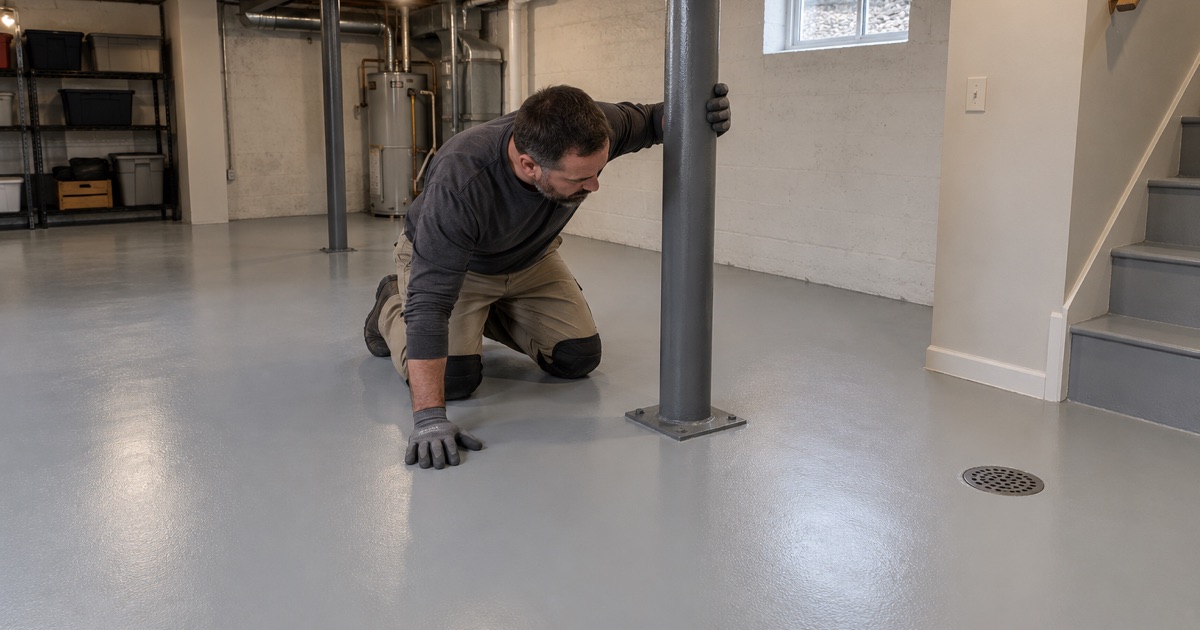
Testing a Below-Grade Slab
We start with an ASTM D4263 plastic sheet taped to the floor, which shows whether moisture is condensing under it. When we need numbers, we use ASTM F1869 calcium chloride kits to measure the vapor emission rate, or drill for ASTM F2170 in-situ relative humidity probes that read conditions inside the slab.
The testing is written into the proposal as its own line item, priced up front, rather than offered after a floor has already blistered. Readings are taken in more than one spot, since the corner by the foundation wall often reads differently from the middle of the room.
Reading the Results Against Product Limits
Every coating and primer has a published moisture limit, and the thresholds in ASTM F710 frame how flooring installers treat those numbers. If the slab reads within the limit of a standard primer, we use one. If it reads higher but within the rating of a moisture-mitigation primer, that primer goes down first and adds a line to the price.
If the readings are beyond what any primer is rated for, we say so and recommend fixing the source before coating. A floor coated over that kind of slab is a floor the manufacturer will not stand behind.
Hydrostatic Pressure and the Seasonal Water Table
When the water table rises in late winter and spring, water in the soil can press up against the underside of a basement slab. That hydrostatic pressure pushes moisture, and sometimes liquid water, through the concrete and into the back of any coating on top.
A basement that tests dry in September can read very differently in April, which is why we ask when the floor has been wet in the past and test with that history in mind.
What Lies Under Evanston Basement Floors
Sandy Ground East of Ridge Avenue
Soil survey maps place excessively drained Plainfield loamy sand under much of Evanston east of Ridge Avenue, along the old beach ridge of glacial Lake Chicago. Water drains through that sand quickly, so a damp basement floor on that side of the city often points to plumbing, downspouts or a cracked lateral rather than groundwater.
That changes the questions we ask. On the sandy side we look hard at where roof water and the sewer lateral go before blaming the soil.
Wetter Soils to the West and Southwest
To the west and southwest, the maps show somewhat poorly drained ground with Elliott soils, which can hold a perched seasonal high water table 1.0 to 2.0 feet down between January and May in most years. A basement there can see real moisture pressure from below for part of the year.
On those floors we test with the season in mind and are quicker to specify a moisture-mitigation primer, because the slab’s driest reading is not the one that decides whether the coating stays on.
Old Slabs, Patches and Paint
With 40.3 percent of the city’s housing units built in 1939 or earlier, many Evanston basement floors are later pours over older ones, or carry patches, toppings and several coats of paint. Each layer is a separate bond line that can let go under a new coating.
We grind back to sound concrete, sound out hollow areas, and cut out and replace sections that are loose. If a slab needs repair before it can be coated, the proposal says so plainly and prices it separately.
Water a Coating Cannot Stop
The Combined Sewer and Basement Backups
Evanston’s whole sewer system is combined, carrying storm water and sanitary waste in the same pipe, and the City spent about $210 million from 1991 to 2008 on relief tunnels and new mains to keep sewage out of basements. Street and alley inlets are throttled with flow restrictors, and the City advises owners to have a plumber inspect the sewer lateral every few years.
A basement floor coating does nothing to stop a backup through a floor drain. It makes the cleanup easier and keeps sewage from soaking into bare concrete, and we describe it exactly that way.
Floor Drains, Sump Pits and Ejector Pits
We stop the coating cleanly at floor drain grates, keep sump lids removable and seal the coating edge around ejector pits, where newer homes send below-grade plumbing up to an overhead line as city code requires in new construction. These edges are where basement coatings most often start to lift, so they get the most attention.
We also look at where the sump discharges. In Evanston it must go to grade at least 3 feet from the house and never into the sanitary sewer, and a sump discharging next to the foundation keeps feeding the wet floor we are about to coat.
Radon Is a Separate Job
A coating seals the slab surface, but it is not radon mitigation, and in Illinois reducing radon for pay requires a license from IEMA. We coat around a mitigation system a licensed contractor installs and keep its suction point accessible, but we never price a floor coating as radon protection.
Basement Epoxy Systems and Finishes
Flake and Solid Color Basement Floors
A flake broadcast floor is the most forgiving finish for a basement that doubles as storage and laundry, hiding lint, dust and scuffs. A solid color floor in a light gray or tan brightens a dim lower level and makes it easier to spot water or a leak early.
Metallic Epoxy for Finished Lower Levels
In a finished basement used as a family room, bar or office, metallic epoxy gives a marbled, glossy finish that reads as a deliberate design choice rather than a utility floor. It needs a smooth, well-prepared slab and a moisture test that clears comfortably, since a fault in the slab shows clearly under a glossy metallic.
Playrooms, Laundries and Home Gyms
A coated slab cleans easily under a washer and dryer, wipes up after children, and takes gym equipment better than carpet or vinyl tile. For lifting areas we recommend rubber mats over the coating, and for laundry areas a texture that stays safe when the floor is wet.
How a Basement Floor Job Runs
Access, Dust and Ventilation
Basement grinding is done with the grinder connected to an industrial vacuum, and we seal off the stairway so dust stays below. The resin goes down with the basement ventilated, and the loud grinding is scheduled inside the City’s construction hours so it does not carry into the evening.
The Proposal, Contract and Warranty
Your proposal names the primer, the body coat, the topcoat and the finished thickness, along with the moisture test and any repairs. Before work starts you receive a written contract and the Home Repair: Know Your Consumer Rights pamphlet the Illinois Home Repair and Remodeling Act requires, and we read the warranty exclusions out loud, starting with moisture.
- 20+ Years in Business
- Moisture Testing in Every Quote
- Written Proposals