
Evanston Epoxy Flooring has spent 20+ years on concrete grinding and surface preparation in Evanston, IL, serving surrounding cities including Lincolnwood, Winnetka, Norridge, Schiller Park and River Grove. Every slab we coat or polish is opened mechanically with a diamond grinder or shot blaster first, because surface preparation, not the coating, is what decides whether a floor stays bonded.
We also grind floors for owners and contractors who need old paint, adhesive or sealer removed, or a slab profiled for a product someone else will install. The work and the finished profile are written into the proposal either way.
Why Surface Preparation Decides the Floor
Bond Is Mechanical
A floor coating holds on by gripping into the texture of the concrete. The International Concrete Repair Institute grades that texture on a scale of concrete surface profiles, CSP 1 through CSP 10, from nearly smooth to heavily roughened.
Each primer and coating names the profile it needs. Thin coatings need a light profile, while heavy mortars and urethane cement need a much rougher one. We grind or blast to the profile the product calls for and check it against reference chips, rather than guessing by eye.
Why We Never Acid Etch
Acid etching is the method most garage kits rely on, and it is the reason many of those floors peel. Acid leaves salts and residue in the concrete, gives a shallow and uneven profile, and does nothing at all to sealers, paint, oil or curing compounds.
Mechanical preparation removes all of those and leaves sound, open concrete. It costs more in equipment and time, and it is the step we will not skip.
Laitance, Sealers and Curing Compounds
The top skin of a concrete slab, called laitance, is weak and dusty, and many slabs were also treated with a sealer or curing compound when they were poured. A coating bonded to that skin or film is only as strong as it is.
Grinding takes the floor down past those layers to hard, sound concrete. A water drop test afterward shows whether the slab now absorbs evenly, a quick check that no sealer is left behind.
Grinding and Shot Blasting Methods
Diamond Grinding
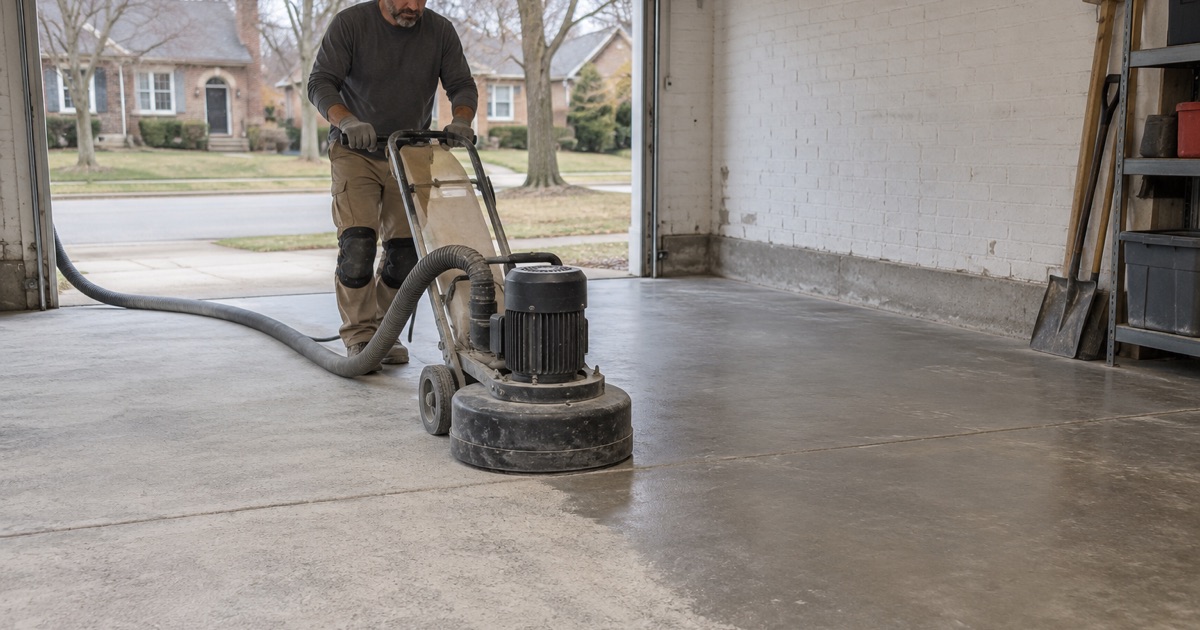
Diamond grinders use rotating heads fitted with metal-bond diamond tooling. Coarse tooling removes coatings and opens the surface quickly, and finer tooling leaves a smoother profile for thin coatings or polishing. Grinding is our standard method for garages, basements and most interior floors, because it handles old coatings well and can be controlled closely near walls, drains and doorways.
Shot Blasting
A shot blaster throws small steel shot at the floor, which bounces back into the machine to be reused while the dust is vacuumed away. It produces a uniform, rougher profile quickly over large open areas. We use it on warehouses, parking structures and floors receiving heavy mortars, where a deeper profile and high production matter more than fine control.
Edge Work and Tight Spaces
Large machines cannot reach the last inches along walls, around columns or inside closets. Those areas are prepared with hand grinders fitted with the same tooling and dust shrouds, so the edges get the same profile as the open floor rather than a lighter pass that fails first.
Edges matter more than their size suggests. A coating usually starts to lift at a wall, a door threshold or the rim of a floor drain, so those are the places we check most carefully before the floor is signed off as ready to prime.
What Comes Off the Floor
Paint and Failed Coatings
Old floor paint and failed epoxy have to come off completely before a new coating goes down. Grinding removes them along with the weak concrete underneath, and we look closely at what the old coating was hiding, from cracks to moisture staining.
If a coating failed because moisture pushed it off, the same thing will happen again unless the slab is tested and treated. We find out which caused the failure before quoting the new floor.
Carpet Glue, Tile Adhesive and Mastic
Carpet glue and tile adhesive gum up fine tooling, so we remove them with coarse tooling or scraping first. Older black mastic adhesives can contain asbestos, so they are tested before anyone grinds them, and a positive result means a licensed abatement contractor handles the removal.
Dust, Noise and Scheduling
Dust Collection
Every grinder and shot blaster we run is connected to an industrial vacuum, and work areas are sealed with plastic where they open to finished rooms. The floor is vacuumed again after grinding, since dust left on the surface weakens the bond of the primer.
In an occupied home we also cover vents and returns near the work area, so fine concrete dust is not pulled into the heating system. Cleanup is part of the job, not something left for the owner when the crew leaves.
Construction Hours and Neighbors
Grinding is the loudest part of any floor job. In Evanston we plan it inside the City’s construction hours of 7:00 a.m. to 7:00 p.m. on weekdays and 8:00 a.m. to 5:00 p.m. on Saturdays, with no Sunday work, and in other towns inside their own hours. For condominium and two-flat jobs, grinding days are scheduled with the association or the other owner before the first machine arrives.
After the Grind
Inspection, Repair and Moisture Testing
Once the floor is open we can see it properly. Cracks, spalls and hollow patches are marked and repaired, and garage and basement slabs are tested for moisture before any primer is chosen. The repairs and the test results go into the proposal or a written change, so the price reflects what the ground slab actually showed.
Ready for Coating, Polish or Another Floor
A properly ground slab is ready for an epoxy or polyaspartic system, a polished finish, or another trade’s floor covering. Whatever comes next, it starts on clean, sound, profiled concrete rather than on the old surface it replaced.
- 20+ Years in Business
- Moisture Testing in Every Quote
- Written Proposals